Acquisition · 10 pages
Buying an off-market business
The natural complement to On-Market: access to targets that are not for sale.
Download ›Access to on-market deals · On-Market
Every acquisition, sale or financing brings in five professions: lawyers, auditors, M&A advisers, lending banks and investment funds. Collaboration Capital extracts these players from every deal completed worldwide, down to the individuals who led it. Rebuilt by sector and by country, this network gives you access to the M&A deal flow — the mandates in circulation and the expertise that executes them — as well as a complete strategic analysis of the market concerned, and a team that approaches business owners and dealmakers directly in most countries.
A business owner who wants to buy, sell or finance a company has no shortage of intermediaries. What they lack is an answer to a simple question: who, in my sector and my country, has actually run deals comparable to mine in recent years — and who holds the mandates today?
This page describes the system that answers that question: the infrastructure that extracts deals, the data model that isolates the five professions involved, the identification of the people behind each firm, a demonstration on a real sector, and what this rebuilt network changes for a buyer, a seller or a borrower.
01 · The problem
When a company is put up for sale by an adviser, or a fund looks to sell a stake, the deal is not publicly announced. It circulates: the mandated adviser selects a few dozen counterparties it knows, sends them a teaser, then runs a process. A buyer who is not on that list will never know the deal existed.
The same mechanism works on the seller's side. An owner who sells usually gives the mandate to the adviser recommended by their accountant or lawyer — rarely to the one who actually ran the last five sales in their sector. The same applies to financing: the banks and funds genuinely active in a sector and a country are not the names that spring to mind.
The reason is structural. Information on "who does what" in M&A is scattered across thousands of press releases, adviser announcements, registers and specialist publications, in every language. No business owner, and no single adviser, can consolidate it by hand. A partner's network — however extensive — remains a sample.
In the intermediated market, access to a deal depends on whether the mandated adviser knows you exist. The problem is therefore not finding companies for sale: it is identifying the mandate holders in your sector and your country, and being on their radar before the process starts.
02 · The infrastructure
Collaboration Capital has deployed an extraction infrastructure that continuously records deals completed in every country and every sector: acquisitions, sales, equity openings and financings. Each deal is recorded with the target, the buyer or seller, the type of deal, the country and the sector. This collection feeds one of the most extensive deal databases on the market, and it forms the first level of the system.
On its own it would only be of statistical interest. What sets On-Market apart is what comes next: each deal is broken down to extract the players, then the people, then — by cross-referencing — the mandates. The diagram below summarises the four levels.
This approach extends the one we apply to off-market sourcing by semantic analysis: rather than relying on an existing database, we build the identification from the public material itself. Both systems rest on the same combination of artificial intelligence and human expertise.
03 · The data model
A corporate finance deal is never the work of a single party. To varying degrees, it always involves five professions. Our data model systematically separates them, because each answers a different question for you.
This split into five professions is what makes the information usable. An undifferentiated list of "advisers" does not help a business owner; knowing that a given law firm documented four sales of testing laboratories in Belgium in three years, and that a given partner signed them, changes the nature of the conversation they can have with that partner.
04 · The people
A law firm or a bank is a brand name. The deal itself was run by two or three people: the partner who led the file, the director who executed it, the relationship manager who took the loan to the credit committee. The sector experience belongs to them, and they are the ones to contact — not a head-office switchboard.
The extraction therefore goes as far as identifying, by name, the competent people on each deal, in each firm. This dual identification — the firm and the person — is what makes it possible to contact the right person, with the right reference, on the right subject.
This point deserves explaining to the business owner who wonders why identify a lawyer or an auditor when looking for a target. An adviser active in a sector receives sell-side, buy-side or financing mandates from its clients. The people who ran yesterday's deals are, in all likelihood, the ones who hold today's mandates. Rebuilding their network means rebuilding the map of the deal flow — a subject we cover more broadly in our analysis on increasing M&A deal flow.
05 · In practice
Using the system comes down to two parameters: a business sector and a country. From these two criteria, On-Market returns within minutes all the firms and people who have run comparable deals — broken down by profession, with the reference deals that justify their place on the list.
What the business owner gets is not a directory. It is the reasoned shortlist of the people they need to meet for their project — and the record of the deals behind that recommendation. Here is how the system fits with our advisory work.
Type of deal — acquisition, sale, financing — sector, target countries, order of magnitude. For an acquisition, this scoping is that of the acquisition thesis; for a sale, that of preparing the sale.
Firms and people who have run comparable deals, returned by profession with the reference deals. You validate the list.
Among the advisers identified, we qualify those holding current or upcoming mandates within your scope, and those relevant to represent you.
You get in touch with the people selected, with the precise reference that justifies the approach. Your identity remains confidential until you decide to reveal it.
Lawyers, auditors, lenders and investors are chosen from those who already know your sector in the country concerned. No exclusivity: you keep your usual advisers if you wish. On this point, coordinating the team on an M&A deal is no minor matter.
06 · The demonstration
The screenshots below come from the application, for a single business sector — building cleaning and facility hygiene — restricted to Europe and North America. They show the three successive views a business owner obtains in minutes: the list of completed deals, their timeline, and all the people who ran them.
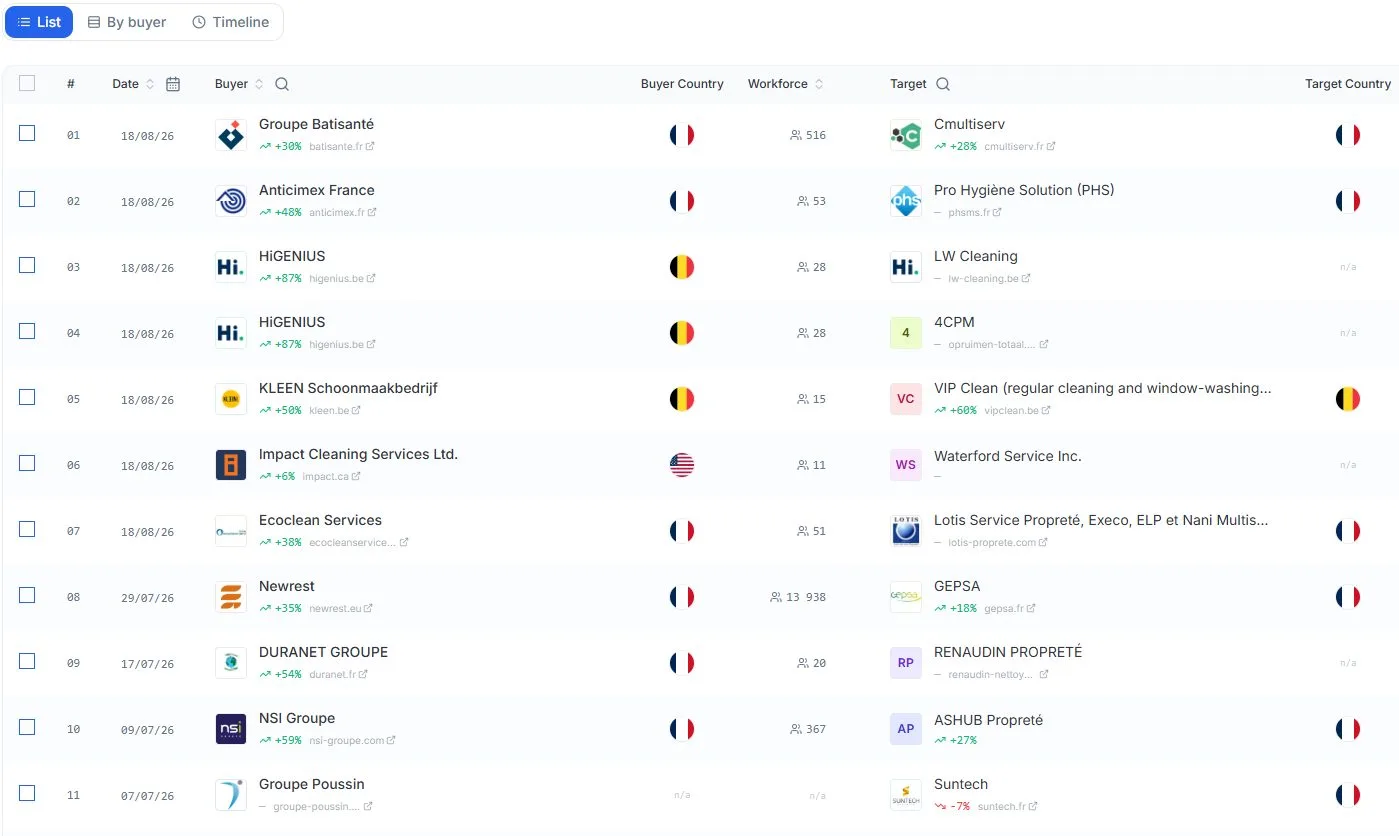
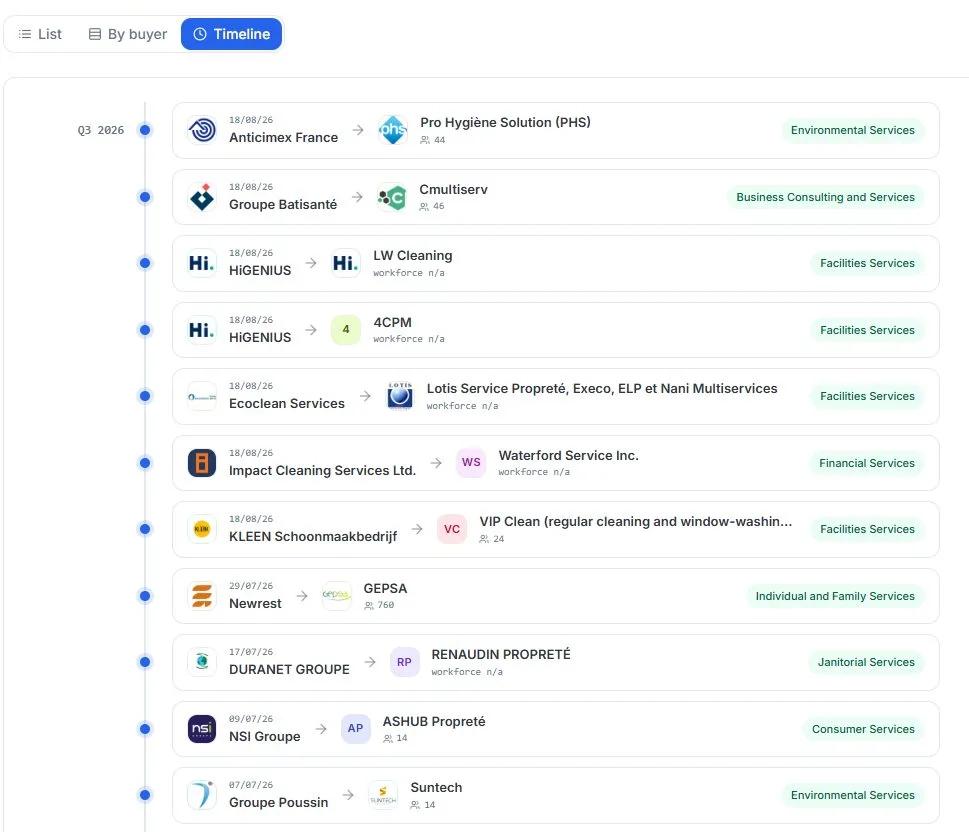
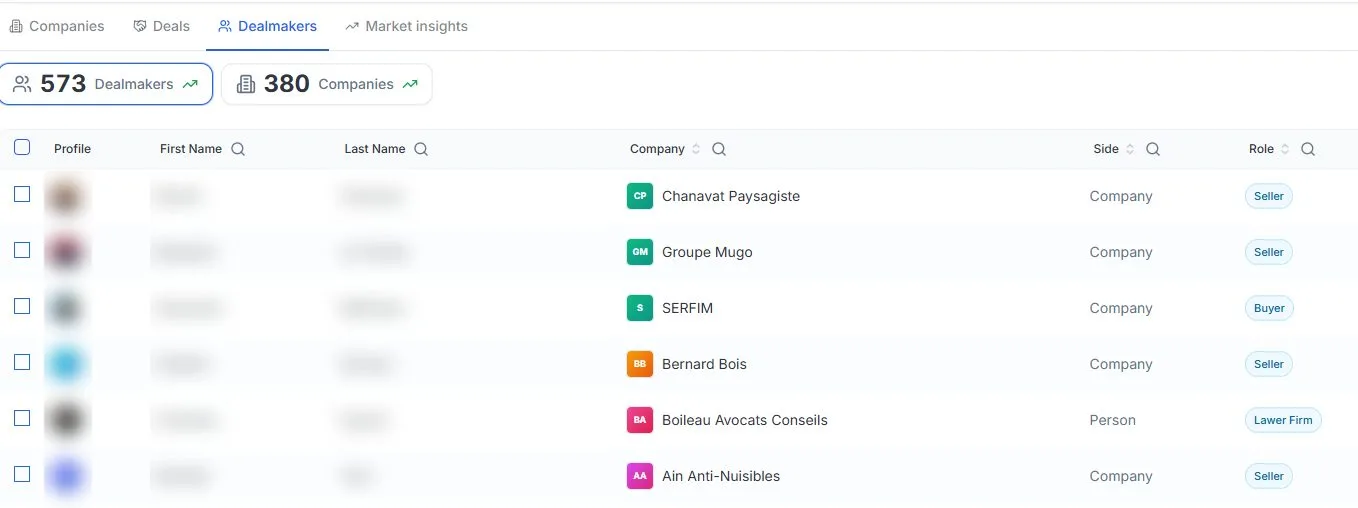
What these three screens do not show, and what falls to our advisory work: qualifying which of these 573 people currently hold mandates within your scope, and making the introductions. The application provides the map; the adviser shows you where to knock.
07 · Strategic market analysis
Deals, buyers, their financial backers, lawyers, funds and banks in a sector, read together on a single screen: Market Insights turns the deal database into a strategic analysis of the market concerned.
Each panel below is calculated automatically on the selected set of deals — here, the 78 deals in the building cleaning sector presented in the previous section. Clicking on a figure, a year or a player opens the underlying deals. And each panel shows the number of deals it is based on: a conclusion drawn from 43 deals does not carry the same weight as one drawn from 3, and the application says so.
When the sector consolidates, and who leads that consolidation.
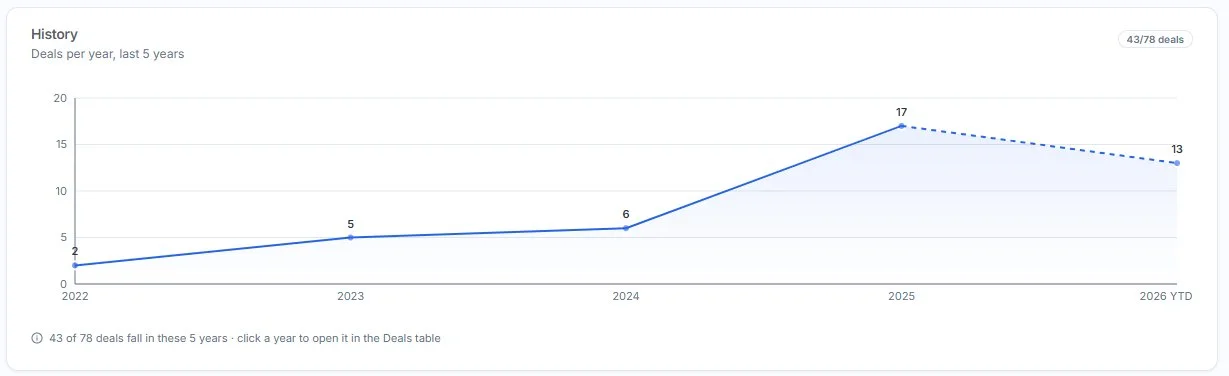
From 2 deals in 2022 to 17 in 2025: the sector has structured itself in three years. A seller reads their exit window here; a buyer reads the urgency of getting there before the others.
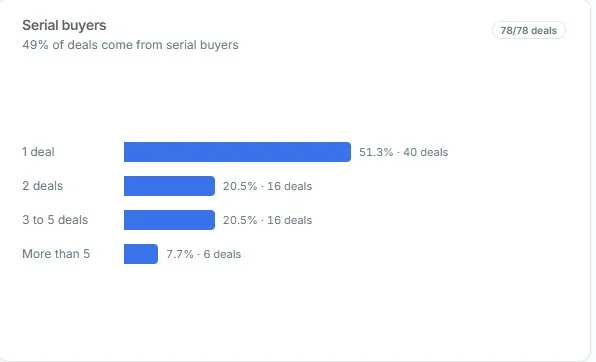
You know half of the likely counterparties in advance. For a seller, it is the shortlist of those who will buy again; for a buyer, it is their competitors for acquisitions.
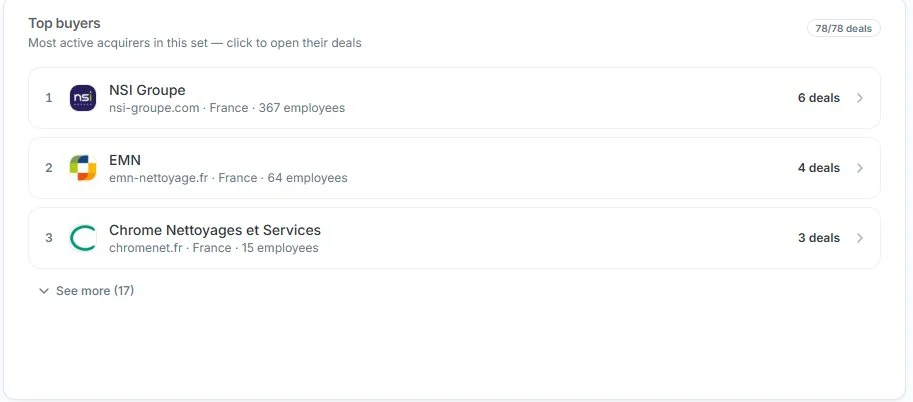
The order in which a seller should be presented to buyers, and the record of deals that justifies that order. Each row opens the deal details.
At what size the market buys, and who buys whom.
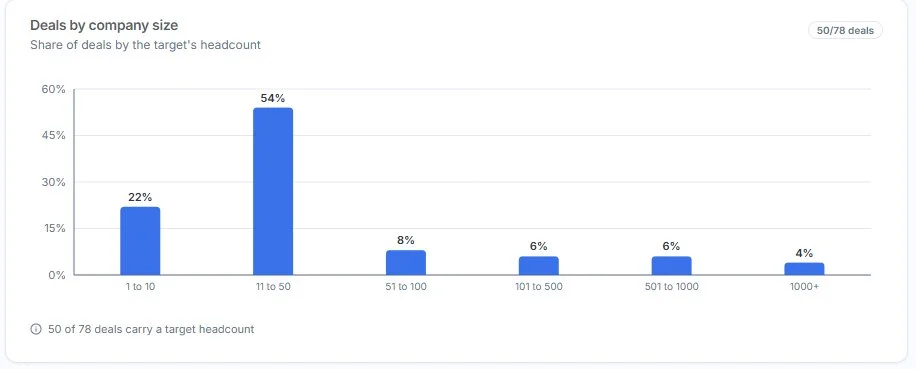
Three targets in four have fewer than 50 employees. A seller of that size knows they are in a liquid segment; a buyer calibrates their thesis on the size actually traded.
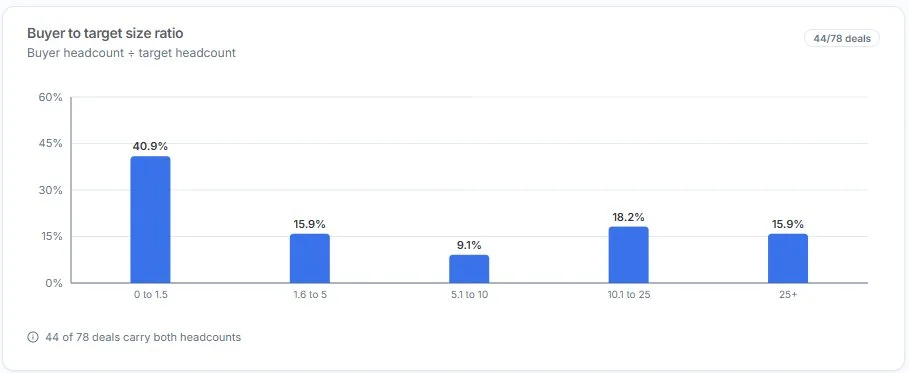
41% of deals bring together companies of comparable size. A seller's buyer list should therefore include similar businesses; at the other end, a third of deals are made by consolidators ten times larger.
Who put up the capital behind the most active buyers.
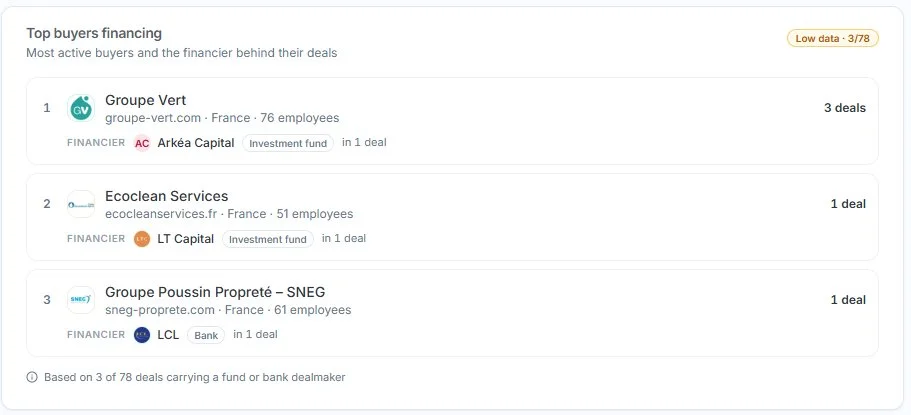
A buyer identifies the lender or investor that backed a comparable buy-and-build; a seller knows which buyers have the means to match their ambitions. The coverage badge shows how many deals the information is based on.
The lawyers, funds and banks that have actually worked in the sector — on the sell side and the buy side.
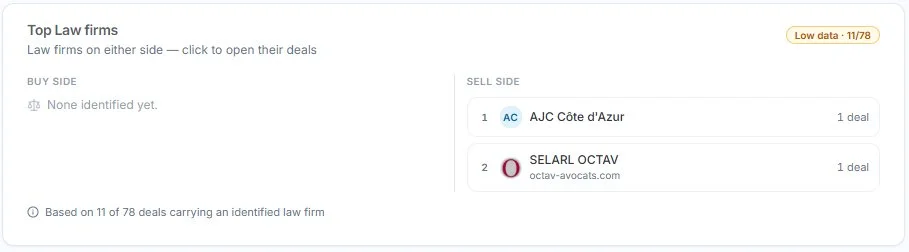
Firms are ranked on the sell side and the buy side: a seller retains a firm that has already acted for sellers in their sector, with the clauses and counterparties it knows.
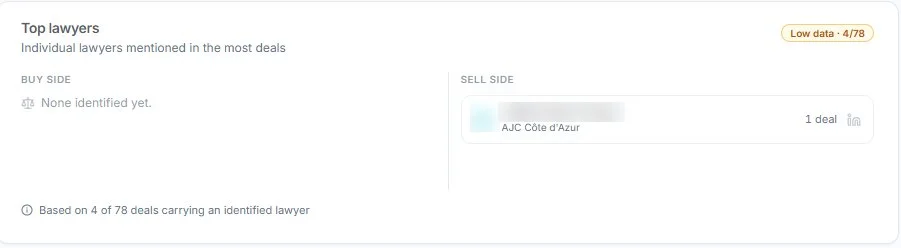
This is the person to contact, with the precise reference of the deal they ran. Identities are blurred on this page; they are available in the application.
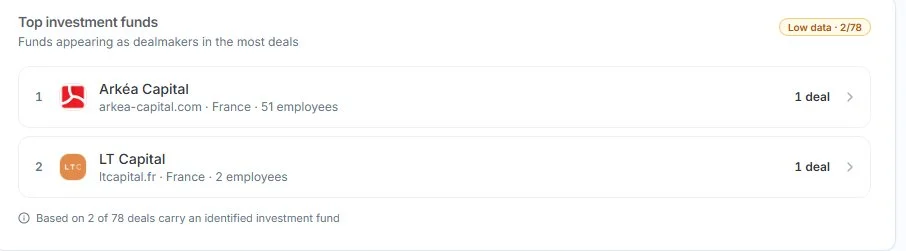
For a fundraising or a sale, these are the investors whose committee already knows the business — and, at their exit horizon, the portfolio companies likely to be sold.
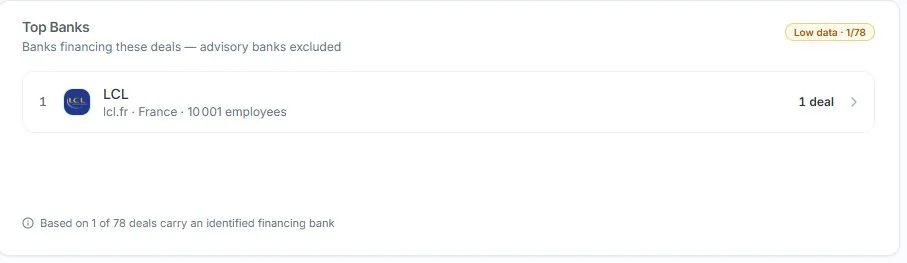
An acquisition finance request goes to the right desk from the first submission, with the reference of the comparable deal the institution financed.
Labels such as "43/78 deals" or "Low data · 3/78" are not an admission of weakness: they show how many deals each conclusion is based on. That is what distinguishes a verifiable market analysis from an opinion. On low-coverage panels, our advisory work completes the information by qualifying the players directly.
Read together, these ten panels answer the questions a business owner asks before committing to a deal: is the sector moving, who is buying, at what size, with what capital, and with which advisers. They feed directly into business valuation and buy-and-build strategy.
08 · Connections & tasks
A sector's network is not built once and for all. Connections & tasks is the module that turns the players identified into a living knowledge base — the accounts and contacts that matter, by sector and by country — and organises the work needed to stay visible to them.
Extraction and Market Insights tell you who did what. The direct approach opens the conversation. In between, a company needs a place to record what it knows about each player, who met them, what was said and what remains to be done. Without this shared memory, every deal starts from scratch and the network stays in the heads of two or three people.
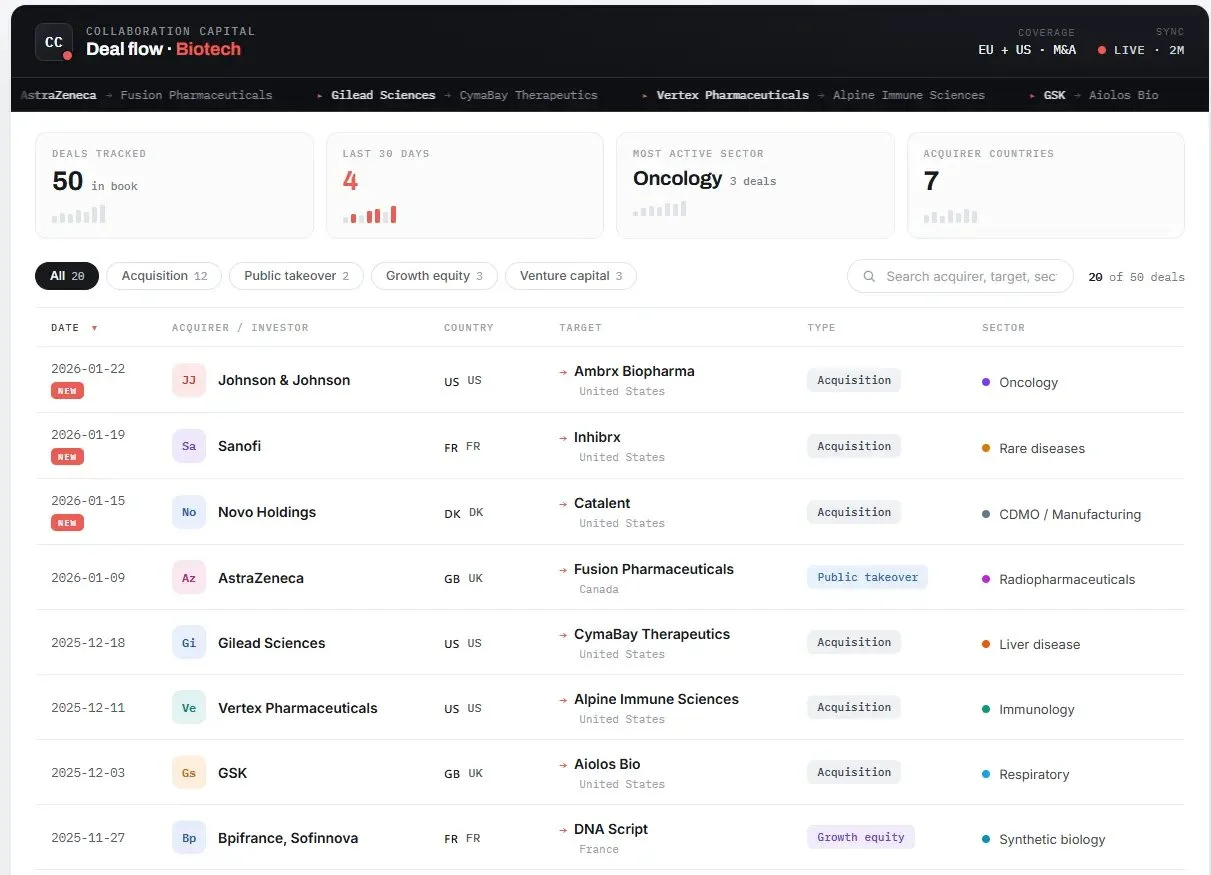
For each business sector and country tracked, the module brings together the accounts — serial buyers, potential targets, advisers, lenders, funds — and the contacts behind them, with their role, deal history and relationship history. Associated tasks — follow-up, meeting, sending a document, progress check — are assigned, dated and visible to the team. The dashboard below gives an overview: deals tracked, those of the last thirty days, the most active sub-sector, buyers' countries, and the list filterable by deal type.
Expertise network
The accounts and contacts tracked are those that have actually run deals in the sector and country concerned — lawyers, auditors, advisers, lenders, funds. The network the company maintains is therefore, by design, the one it will need on the day of a deal.
Internal collaboration
The base is shared: a subsidiary manager, a business development director, an in-house lawyer or a finance director see the same accounts, contacts and tasks. Each contributes within their own scope — a country, a business line, a subsidiary — and together they build a shared memory that does not disappear when someone leaves.
The mechanism is simple and grows stronger with every cycle. A company that maintains regular relationships with a sector's dealmakers in a country is known to them as a credible buyer or a well-prepared seller. When they are given a sell-side mandate, it is on the shortlist — before the process, not after. Each exchange brings new connections, which enrich the base, and the cycle starts again. That is how, deal after deal, access to the best sell-side mandates in the sector is built.
A CRM records what you enter into it. Connections & tasks starts from the deal database: the accounts and contacts suggested are those that have already acted in your sector and your country, with their reference deals. You are not filling an empty database — you are enriching a map that has already been built. On how a dedicated tool transforms deal flow tracking, read why M&A software is becoming indispensable.
09 · The direct approach
Identifying a sector's players is not enough. A rebuilt network only becomes an opportunity when a competent person picks up the phone, in the business owner's language, with a precise reason to call — and gets in return information, a mandate, or permission to present a deal.
This is the part of the system the screen does not show, and it makes the difference between a database and a deal flow: the direct approach to business owners, shareholders and professionals who hold mandates. It rests on systematic preparation, a conversation always conducted in the same order, and a team trained in M&A, present in most industrialised countries.
Before any approach, the team analyses the contact's market: acquisitions and sales completed, acquisitive growth strategies observed, the positioning and business lines of their company, the owners, shareholders and advisers involved in comparable deals, and the industrial, commercial or geographical fit with the project presented. This preparation is fed directly by the deal extraction and by Market Insights.
The effect is immediate: within the first few sentences, the business owner understands that their company was not picked at random and that the person calling knows the issues in their sector. A prepared call gets a conversation; a generic call gets a polite refusal.
The decision-makers' business contact details are identified, then contact is made directly, by phone and email. Each exchange follows the same progression: demonstrate an understanding of the company and its environment; explain why this profile is relevant to the project; present the deal clearly, confidentially and attractively enough; qualify interest, criteria and timing; build trust before any sensitive information is shared. The aim is not to multiply approaches, but to create targeted exchanges with the people genuinely able to contribute to the deal.
On cross-border deals, the conversation is led by someone from the country, in the business owner's native language. This is not a nicety: a business owner approached in their own language responds, and responds better — and the quality of the information obtained depends on that first exchange.
The people who conduct these conversations are trained in understanding M&A deals, sector analysis and holding discussions with business owners. They know how to present a deal, answer initial objections, preserve confidentiality and quickly identify the conditions needed for discussions to continue. Each exchange is qualified in a structured way — level of interest, investment or sale criteria, target size, sectors, geography, timing, next steps — recorded in the application and visible to the client.
Because it targets business owners and professionals who do not communicate publicly about their intentions, the direct approach widens the accessible market well beyond listings and deals already in the hands of intermediaries. It makes it possible to detect companies that may consider a sale, identify buyers with an active acquisitive growth project, build relationships with advisers holding relevant mandates, obtain permission to present these opportunities to our clients — and build, deal after deal, a proprietary network of qualified business owners and intermediaries.
Extraction produces the market map; the direct approach turns that map into relationships of trust; those relationships become qualified mandates and concrete opportunities for our clients. None of the three links works without the other two.
On what a confidential exchange really protects before an agreement is signed, read confidentiality and NDAs: what really works; on coordinating these exchanges with your own teams, the role of teamwork in an M&A deal.
10 · The benefits
The benefits differ depending on which side of the table you sit. We set them out for each situation.
Buyer
You identify the advisers selling in your sector and make yourself known to them as a credible buyer with financing in place. You are on the distribution list for the next teaser instead of reading about the deal in the press. Combined with off-market sourcing, your deal flow covers both sides of the market.
Seller
You know who has actually sold companies like yours, in your country, over the last three years — and to whom. You appoint an adviser with full knowledge of the facts, you negotiate fees better, and you know which buyers and funds have already acquired in your sector. Our criteria for choosing an adviser for an M&A deal complete this picture.
Borrower or fundraising
You identify the banks whose credit committee has financed comparable deals and the funds investing in your line of business, along with the relationship manager or partner concerned. Your file goes to the right desks. See obtaining financing and structuring acquisition finance.
Cross-border deal
Abroad, the first obstacle is not the target: it is knowing whom to trust with local law, due diligence and financing. The sector × country network provides that team, with its track record. See our cross-border deals and succeeding with an M&A deal abroad.
Two key takeaways
For your sector and your country, the extraction produces a map of repeat buyers, funds approaching exit and the multiples paid on comparable deals. This market reading feeds into the valuation of your business and the preparation of your letter of intent.
11 · The shift
Corporate finance advisory has historically rested on an asset that is hard to challenge: the partner's address book. An adviser is good because they know the right people; they know the right people because they have done deals; and they do deals because they are well known. For the client, this model has three structural limits.
It is local and sector-bound by design. A partner has a network in two or three sectors and one or two countries. Beyond that, they improvise or subcontract.
It is opaque. The client cannot check that the network claimed actually exists, or that it is the most relevant for their deal.
It locks you in. Because the network belongs to the adviser, the adviser protects it through mandate exclusivity and by withholding information.
On-Market reverses this logic. The expertise network is no longer a partner's private asset: it is data rebuilt from real deals, verifiable, and available for every sector and every industrialised country. Collaboration Capital thus becomes, to our knowledge, the first firm to provide a genuine architecture of expertise — the network of relevant lawyers, auditors, advisers, lenders and funds — for any sector and any country, in minutes rather than over a career.
This shift does not remove human advice; it moves it. The time no longer spent on "finding out who knows whom" goes into qualification, negotiation and execution — the phases where a practitioner's experience really makes the difference. That is the logic of our method combining AI and human expertise, and more broadly that of the new digital tools in M&A.
12 · On-Market and off-market
The market for companies divides into two sets that do not follow the same rules. The intermediated market — deals under mandate — is competitive and structured, and access depends on advisers. The hidden market — companies that are not for sale — is larger, has no process, and access depends on identifying and approaching the business owner.
A serious buyer covers both. A seller, for their part, uses On-Market to choose their adviser and know their likely buyers, then off-market sourcing to widen the buyer list beyond the "usual suspects". We describe each approach on our pages on business acquisition, selling a business and international business acquisition.
13 · Our positioning
We are an independent advisory firm for acquisitions, sales and financing, working in France and internationally through a network covering 120 countries, on deals of EUR 1–200 million. The firm is registered with ORIAS, the French register of insurance and banking intermediaries, under number 25000696 as a broker in banking transactions and payment services (IOBSP).
No exclusivity imposed. You keep your usual advisers and can withdraw the file at any time.
Structural independence. No bank and no fund among our shareholders; no remuneration paid by the firms identified, which do not pay to appear in the results.
Artificial intelligence and human expertise. Extraction is automated; qualification, approach and negotiation remain in the hands of practitioners.
Confidentiality. Your identity is only revealed to counterparties when you decide; a non-disclosure agreement is available on request. On what really protects a deal, read confidentiality and NDAs: what really works.
Our completed deals, our case studies and our partner network show how this system is used on real files.
14 · Resources
The guides below can be downloaded free of charge in PDF format. In a few pages, they set out the method, the points to watch and the mistakes to avoid on each subject.
The natural complement to On-Market: access to targets that are not for sale.
Download ›The first binding document in an intermediated process: key clauses and legal scope.
Download ›What really protects your data during a competitive process.
Download ›Fifteen points to check before appointing an adviser and signing.
Download ›See all 11 practical guides · Download our document templates
Preparing a financing instead? Our pages on obtaining financing, fundraising and our borrowing capacity simulator cover the subject from the borrower's side.
15 · Frequently asked questions
An on-market deal is a company whose sale, acquisition or financing has been entrusted to an intermediary under a mandate. The deal circulates among counterparties selected by that adviser, without any public announcement. To access it, you need to be identified by the right adviser at the right time — which means knowing who holds the mandates in your sector and your country.
Off-market sourcing identifies companies that are not for sale and approaches their owner directly. On-Market starts from deals already completed or under way to identify the advisers, lenders and funds active in a sector and a country, then access the mandates they hold. The two approaches complement each other: one opens up the hidden market, the other the intermediated market.
For each deal: the target, the buyer or seller, the type of deal, the country and the sector, then the five professions involved — lawyers, auditors, M&A advisers, lending banks, investment funds — at the level of the firm and of the people who ran the deal.
Yes. The infrastructure extracts deals of all sizes as long as they have left a public trace: adviser announcements, press releases, registers, specialist press. Coverage is denser for intermediated deals than for confidential sales between private individuals, which fall within off-market sourcing.
Because, together with M&A advisers, they are the ones who see a sector's deals before they close, and because you will need them to execute yours. A lawyer who has documented four sales in your sector knows the usual clauses, the usual counterparties and, often, the next deals in preparation.
No. We are an independent firm, with no bank or investment fund among our shareholders, and we are not paid by any counterparty to the deal. The firms identified do not pay to appear in the results.
By phone and email, after an analysis of their sector and deals, by someone from their country who speaks their language. The conversation follows five steps: demonstrate an understanding of the company, explain why the profile is relevant, present the deal confidentially, qualify interest and timing, build trust before any information is shared. Each exchange is recorded in a qualification sheet visible to the client.
No. We do not ask for any exclusivity. The network identified complements your existing advisers where they lack sector track record or presence in the country concerned. You decide who is on your team.
Access is through the Collaboration Capital platform, after an initial scoping call. Existing clients log in from the client area; others can request a demo using the form below.
The information on this page describes a method and market observations. It does not constitute personalised advice, nor any commitment as to the results, timing or terms of a deal. Each case is assessed on its own facts.
An expertise network by sector and by country, verifiable deal by deal
No exclusivity, no fixed fees
IOBSP broker — ORIAS no. 25000696
A first confidential 30-minute call to scope your project and show you your sector's network.
A first 30-minute call with a partner: we scope your project and show you, during the session, the firms and people active in your sector and your country — with no commitment.
Reply within 24 business hours
Confidentiality — non-disclosure agreement on request
IOBSP broker registered with ORIAS under no. 25000696
Further reading
Acquisition thesis, hidden market, semantic sourcing, valuation and financing.
Preparing the sale, choosing your adviser, identifying buyers and securing the deal.
How we combine automated extraction and practitioner work on every file.