Off-market · Proprietary sourcing & direct approach
Off-market deal sourcing: approaching companies that are not for sale
Our off-market deal sourcing starts with a sector-wide extraction infrastructure that continuously identifies the companies matching your acquisitive growth project, in your sector and in the countries you select. Our deal team then approaches each owner-manager in confidence and qualifies their genuine interest before any introduction is made. Deals from EUR 1 to 200 million, with no exclusivity required.
The off-market channel is not about consulting a different database. It is about rebuilding, yourself, the complete list of companies in a sector, then asking each owner-manager what they have in mind for their shareholding. The two steps are inseparable: a list without an approach produces nothing, and an approach without a complete list only reaches the visible third of the market.
This page describes the full set-up Collaboration Capital runs on this channel: the sourcing sequence carried out by our artificial intelligence infrastructure, followed by the direct approach sequence carried out by our deal team. It explains what each step produces, what the client receives, and what this set-up changes compared with the way acquisition and sale advisory usually works.
01 · The problem
Why the visible market does not contain the best off-market acquisition targets
A buyer working from transaction and financial databases is looking at a sample, not a market. Two mechanisms explain the gap.
Confidential accounts. In France, micro-enterprises can declare that the annual accounts they file with the commercial court registry will not be made public, and small companies can ask for their profit and loss account to be kept confidential — an option provided by Article L. 232-25 of the French Commercial Code. A company that uses this option disappears from financial databases, whatever its size, profitability or relevance to your project.
Imprecise industry codes. An activity code describes a company as it registered itself, sometimes twenty years ago, not as it operates today. A highly specialised precision subcontractor may be registered under a generic heading that says nothing about its real expertise.
What this means
The difficulty is not reaching companies that are not visible: it is knowing they exist. No amount of skill in the approach makes up for an incomplete starting list. It is first an identification problem, and only then a prospecting problem.
This page covers the off-market channel. For companies formally up for sale and available mandates, see access to on-market deals. The advantages and risks specific to off-market deals are compared in our analysis buying a business off-market.
02 · The set-up
Two inseparable sequences: proprietary deal sourcing and direct approach
The off-market set-up works as one continuous chain. The first sequence is technological: it turns the description of an acquisitive growth project into a list of qualified, enriched and documented companies. The second is human: it turns that list into positions expressed by owner-managers, documented and actionable. Each milestone produces a deliverable that you approve before moving on to the next.
03 · Sourcing
An AI infrastructure that extracts an entire sector, country by country
We have developed an artificial intelligence infrastructure that continuously extracts the companies in a business sector, in the countries selected in Europe, North America, Asia and Africa, starting from nothing more than the description of an acquisitive growth project. It depends neither on published accounts nor on administrative industry codes: it works on the language each company uses to describe its own business.
This extraction is continuous, not a one-off. A sector moves: companies are set up, merge, change hands and reposition themselves. A list frozen on the day it is delivered is out of date within a few months. Ours keeps updating for as long as the project remains open.
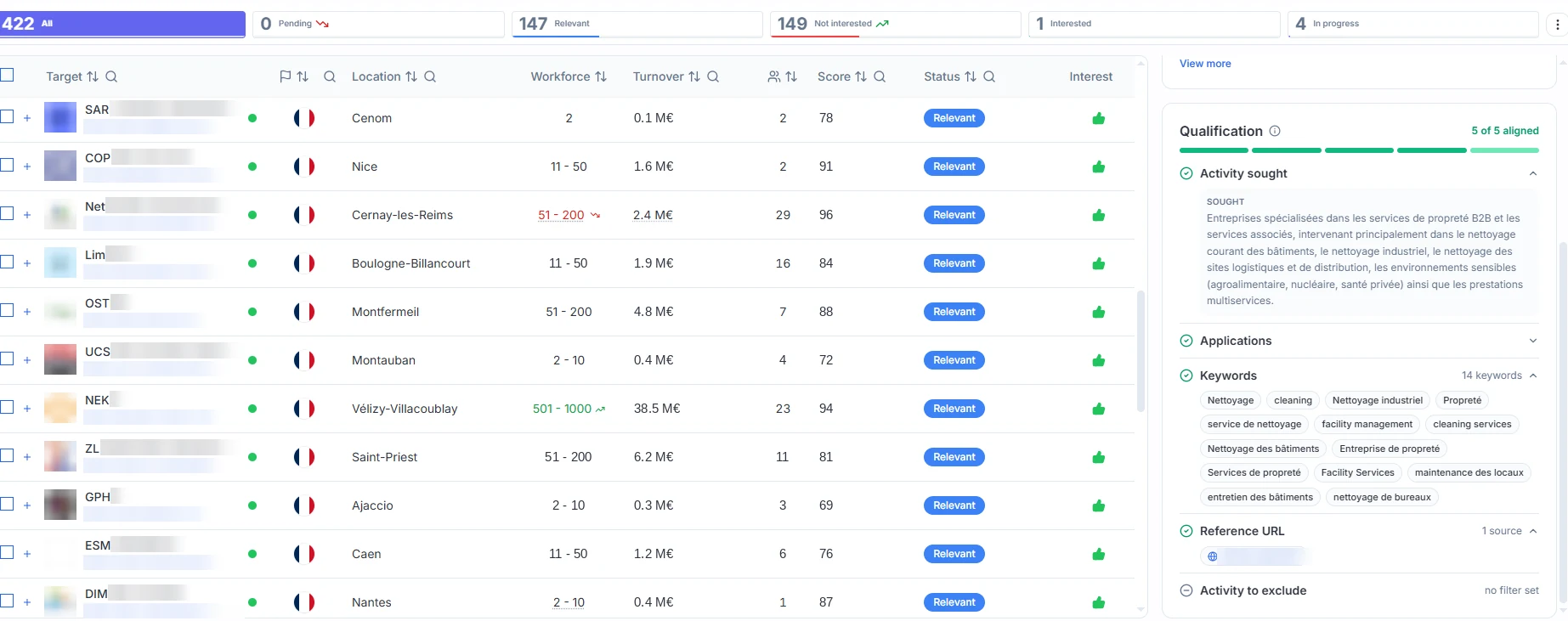
What this view shows is the central deliverable of the sourcing sequence: the deal set. Each row is a company identified from the vocabulary of its own website, not from an activity code. The right-hand panel shows the criteria that define the scope — target activity, keywords in the semantic cluster, excluded activities. Changing these criteria changes the list: this is where scoping happens, before any contact is made.
The counters in the top bar track the campaign's progress: companies extracted, judged relevant, ruled out, interested, in discussion. This is the dashboard you share with our deal team for the whole duration of the project.
The technical principle — building a semantic cluster in the language of the target market — is explained on our business acquisition page and in our presentation of the DEAL Diamond method.
04 · The sourcing deliverable
Six layers of enrichment for every target we put forward
A sourced company is not a row in a spreadsheet. It is a profile built in six layers, from raw identification through to the owner-manager's contact details. Each layer answers a specific question a buyer asks before deciding whether an approach is worth making.
These six layers serve a single purpose: no call is ever made blind. An owner-manager approached by someone who knows their shareholding, their deal history and the names of their advisers gives an attention that the same call, poorly prepared, never gets. The quality of the data determines the quality of the conversation.
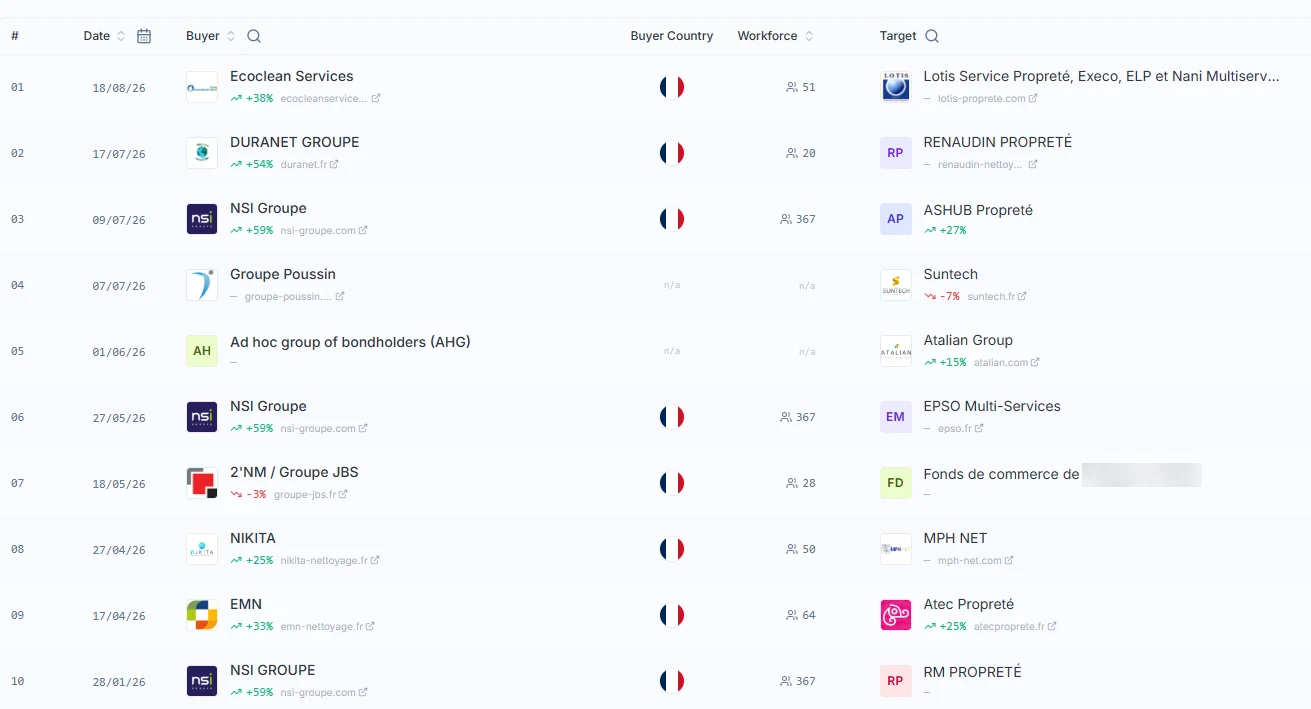
This view is the fourth layer applied to each target: the sector's ownership history. It lists the deals completed, showing for each one the buyer, its country, its headcount and the target acquired. Two insights follow directly.
Serial buyers stand out on their own. A buyer that appears three times in a few months is running an openly declared buy-and-build strategy. On a sale project, it is a counterparty qualified before the first contact. On an acquisition project, it is a competitor whose pace you need to know.
A target's track record can be pieced together. A company that has already acquired two businesses has negotiating experience, financing capacity and often a financial investor among its shareholders. It is not the same counterpart as a founder-owner who has never done a deal — and the approach is not prepared in the same way.
Personal data
The contact details collected are owner-managers' business contact details, processed under the GDPR on the basis of legitimate interest, with the person informed from the very first contact and an immediate right to object. Our legal notice explains how to exercise these rights.
05 · The direct approach
How we approach owner-managers directly, in five steps
Approaching an owner-manager who has not asked for anything leaves no room for improvisation: a failed first conversation closes the door for a long time. Our method meets this constraint with a stable sequence, applied target by target.
Here is the profile the deal executive has in front of them during the call, and completes after the conversation. The left-hand column holds the scoping data — revenue, EBITDA and margin, headcount, actual activity — and the position gathered from the owner-manager. The central block holds the assessment: seven weighted criteria, scored by each assessor and aggregated into a single score.
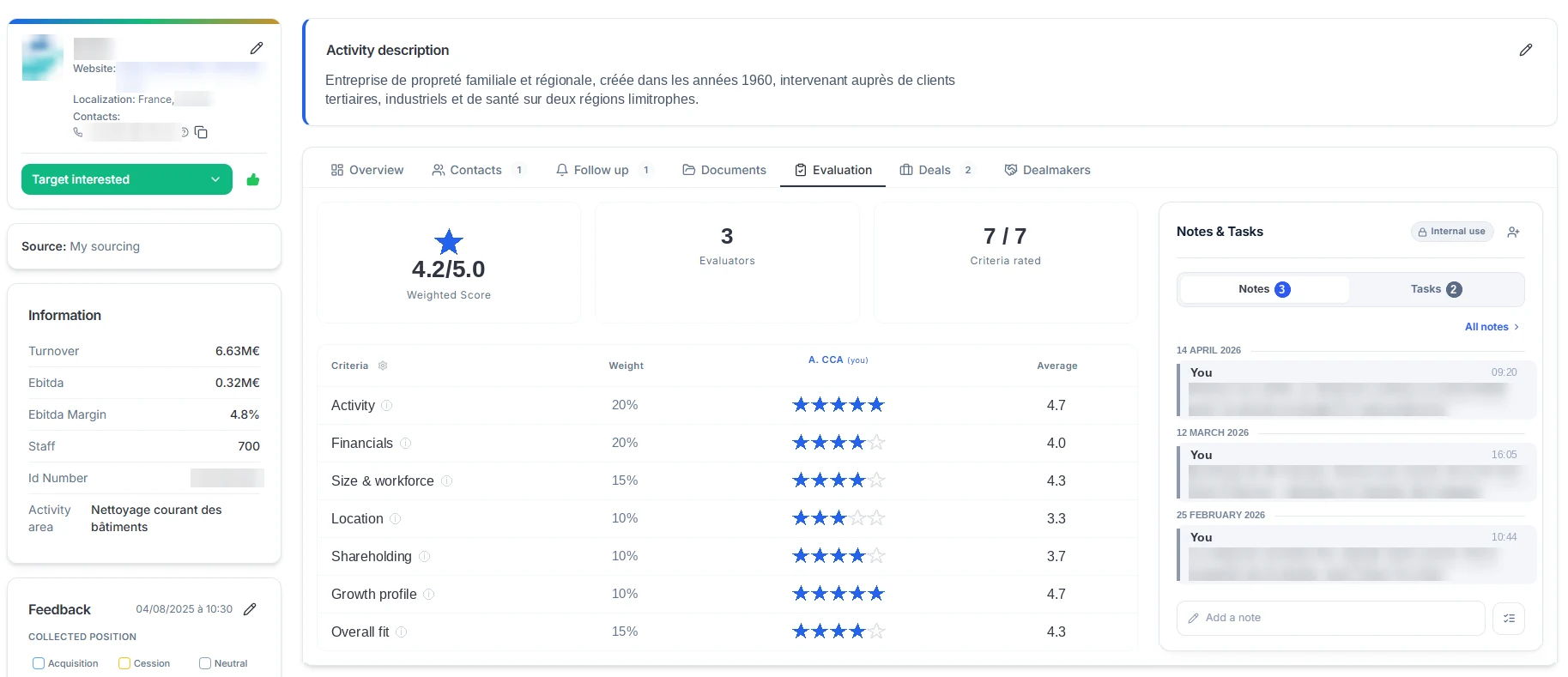
Three things are worth noting in this view. The “Target interested” status is not self-declared: it follows from the qualification grid described below, and it determines what happens next. The weighting of the criteria is specific to your project — if location matters little in your investment thesis, it carries little weight in the score, and two clients looking at the same company do not get the same score. Finally, the number of assessors makes it clear that the score is not one person's opinion.
The note thread on the right keeps the history of the relationship: three dated exchanges and two open tasks on this target. Their content is masked here — it is client information — but this thread is what allows a file to be picked up six months later without starting from scratch, and this same space receives the approach reports described in step 05.
STEP 01
Preparing the approach
Each shortlisted target is enriched with information identifying its main shareholders — including any private equity fund — and the key events in its history, in particular the acquisitions it has already made. Before the call, the deal executive has a precise understanding of the company they are about to contact.
STEP 02
Making contact and putting the scenarios in perspective
We introduce ourselves to the owner-manager by sharing upfront what we know about their shareholding and their company's history. This does two things at once: it establishes the credibility of the call, and it sets the conversation on a peer-to-peer footing rather than a sales pitch. On that basis, we suggest discussing their current challenges and looking at the possible paths forward, both for the shareholding and on a personal level.
STEP 03
A confidential, gradual conversation with no commitment
The first conversation is conducted in listening mode, without assuming any wish to sell. It brings out the owner-manager's priorities, constraints and vision for the company's future, from a strategic as well as a wealth and personal perspective.
Strict confidentiality from the very first contact.
A tailored approach that respects the owner-manager's timetable and availability.
No sales pressure and no premature commitment.
A clear presentation of the project's origin, credibility and objectives.
Information shared gradually, in line with the level of interest expressed.
The owner-manager stays in control of whether the discussions continue, at every stage.
Discussions can be secured by signing a non-disclosure agreement (NDA) before any sensitive or identifying information is shared — a document whose strength rests on a few precise clauses. This framework makes it possible to discuss very different scenarios calmly: a full or partial sale, opening up the share capital, an industrial combination, an acquisition, a gradual handover, or simply longer-term strategic thinking.
The aim is not to force an immediate decision. It is to let the owner-manager assess, in complete confidence, the options likely to serve their interests, those of their shareholders and the long-term future of their company.
STEP 04
Assessing the level of interest
After each conversation, the owner-manager's level of interest is qualified. This qualification is not based on an impression: it relies on a structured analysis grid covering their motivations, any reservations, their decision timetable, the terms they have in mind and their willingness to take a next step.
This method separates three groups that are often confused: owner-managers who are genuinely receptive, projects that need time to mature, and opportunities that can quickly lead to in-depth discussions. Each position is documented, together with the relevant actions that follow from it.
STEP 05
The report shared in the collaborative workspace
A structured report is written after each conversation and made available to you in the platform's secure collaborative workspace. It sets out the information gathered from the owner-manager, the recommended next steps and proposed time slots for the first video call between the parties.
06 · Qualification
How to read an owner-manager's level of interest
A “no” is almost never a final no, and a polite “yes” is not a commitment. The value of a direct approach campaign lies in how finely these positions are distinguished, then dated. An owner-manager who answers “not for another three years” is not a failure: it is time-stamped information that will be worth a great deal at the right moment.
The by-product of this discipline is often as useful as its direct result. At the end of a campaign, you have a complete map of your sector: who is open, who is not, who might be in two years' time, and who advises each of them. This material builds up from one project to the next and feeds your M&A deal flow over the long term.
07 · The benefits
What off-market deal sourcing changes in practice for a client
The benefits play out on four distinct levels: what you see, what you pay, what you know before you speak, and what you keep once the deal is done.
A whole market, not its visible third
The extraction depends neither on published accounts nor on activity codes. Companies with confidential accounts, subsidiaries that could be carved out and businesses whose expertise does not match their industry code come up like all the others.
No organised auction process
A company formally up for sale is put into competition by design, and presented in its best light. A company approached directly has no imposed timetable and no counter-offer on the table — the discussion is about the project before it is about the price.
You know the target before you make contact
Shareholding, buy-and-build history, network of advisers, position expressed by the owner-manager: the first video call starts from a documented base, not from mutual discovery.
A continuous flow rather than a frozen list
The extraction stays active as long as the project is open. New companies, changes in shareholding and deals completed in the sector feed the deal set continuously.
Every approach leaves a usable record
Structured reports, dated positions, next actions: the collaborative workspace keeps the complete history. Today's refusal becomes an identified lead for your next project.
No exclusivity required
You remain free to consult other advisers, to involve your own lawyers and accountants, and to withdraw the mandate from us at any time.
08 · A market shift
What this set-up changes in acquisition and sale advisory
The dominant model in deal advisory is based on inventory: an intermediary holds mandates, circulates them to a circle of buyers and is paid on the match. This model has a structural consequence that is rarely stated — the universe shown to the client is the one the intermediary owns, not the one that fits the client's project.
The off-market set-up reverses this logic. The starting point is not a portfolio of mandates but the description of an acquisitive growth project. The universe is rebuilt for that project, and for that project alone.
The shift therefore does not lie in the use of artificial intelligence as such — a tool does not create a deal. It lies in what AI makes possible: running an exhaustive search across an entire sector for a single client, at a cost that made the exercise impractical by hand, then devoting human time to what it does best — talking to owner-managers. Technology moves human work to where it creates value; it does not replace it. We explain this further in our analysis of digital tools and AI in M&A.
09 · How we work
Scope, commitments and regulatory framework
Collaboration Capital is an independent advisory firm specialising in acquisitions, business sales and financing. No bank or private equity fund holds any of its share capital, and the firm is not paid by any counterparty to the deal.
Deals valued at EUR 1–200 million, on both the buy side and the sell side.
Coverage of 120 countries — Europe, North America, Asia and Africa — with approaches conducted in the language of the market.
No exclusivity required: you consult whoever you wish and withdraw the mandate whenever you choose.
Client approval at every milestone: you approve the target list before any contact is made.
Broker in banking transactions and payment services (IOBSP), registered with ORIAS — the French register of insurance, banking and finance intermediaries — under no. 25000696.
The set-up applies equally to an acquisition project and to a business sale project: in the latter case, the extraction targets potential buyers — trade buyers in the sector, serial buyers, funds pursuing buy-and-build strategies — and the direct approach targets their senior executives.
The orders of magnitude on this page reflect practices observed in the market and our own deals. They do not constitute personalised advice, nor any commitment as to the terms, timetable or outcome of a deal. Each case is assessed on its own merits.
10 · Resources
Guides and analysis on off-market deal sourcing
Our practical guides condense the method, checklists and points to watch on a topic into a few pages. They can be downloaded as PDFs.
Buying a business off-market
Accessing off-market targets: less competition, better terms, and the risks to manage.
Download the guide ›Confidentiality & NDA
The non-disclosure agreement template that genuinely protects your data during negotiations.
Download the guide ›The letter of intent (LOI)
Drafting a robust LOI: key clauses, legal effect and mistakes to avoid before committing.
Download the guide ›Our analysis of direct approach and deal sourcing
Browse the 11 practical guides · Browse all articles · Read our case studies
11 · Frequently asked questions
Your questions about off-market deals
An off-market company has not been formally put up for sale and is not in contact with any buyer. The approach is made directly to the owner-manager. The advantage is twofold: access to targets your competitors do not see, and no organised competitive process — and therefore no auction dynamic on the price.
Identification is not based on financial data but on the language each company uses to describe its business: processes, materials, certifications, markets, references. This vocabulary is public even when the accounts are not. Our infrastructure scans this material and retains the companies whose wording matches the scope of the project.
No, not when contact is first made. The approach is conducted by our deal team, and your identity is only revealed with your consent, at the point where the owner-manager's level of interest justifies it. A non-disclosure agreement can be signed before any identifying information is shared.
Their position is documented, dated and kept in the collaborative workspace: reason for declining, any conditions, stated time horizon. An owner-manager who says they will not consider anything for three years provides information that will count for a later project. No follow-up is made outside the framework they have set themselves.
The on-market channel gives access to companies formally up for sale and to available mandates: the information already exists, and the work consists of sorting it and positioning yourself. The off-market channel means rebuilding the universe of companies, then qualifying the interest of each owner-manager. The two channels are complementary and are often run in parallel on the same project.
The extraction is carried out in the countries selected for the project, in Europe, North America, Asia and Africa, with a network covering 120 countries. It is built in the language of the target market rather than through translation, which determines both the quality of identification and response rates to the approach. The set-up works for any sector whose companies describe their business online.
No. We do not ask for any exclusivity: you remain free to consult other advisers, to involve your own lawyers and accountants, and to withdraw the mandate from us at any time.
The contact details collected are owner-managers' business contact details, processed in accordance with the GDPR on the basis of legitimate interest. The person concerned is informed of the source of the data from the very first contact and can immediately exercise their right to object, as well as their rights of access, rectification and erasure.
First conversation
Start an off-market search
A 30-minute first conversation with a partner to scope your acquisitive growth or sale project, define the sector and geographical scope of the search, and agree the compliance criteria applied to each target — with no commitment.
Further reading
The on-market channel: companies formally up for sale, available mandates and deal tracking.
The complete method: acquisition thesis, assessment, valuation, financing and legal protection.
Running a series of acquisitions rather than a one-off deal: pace, financing, integration.